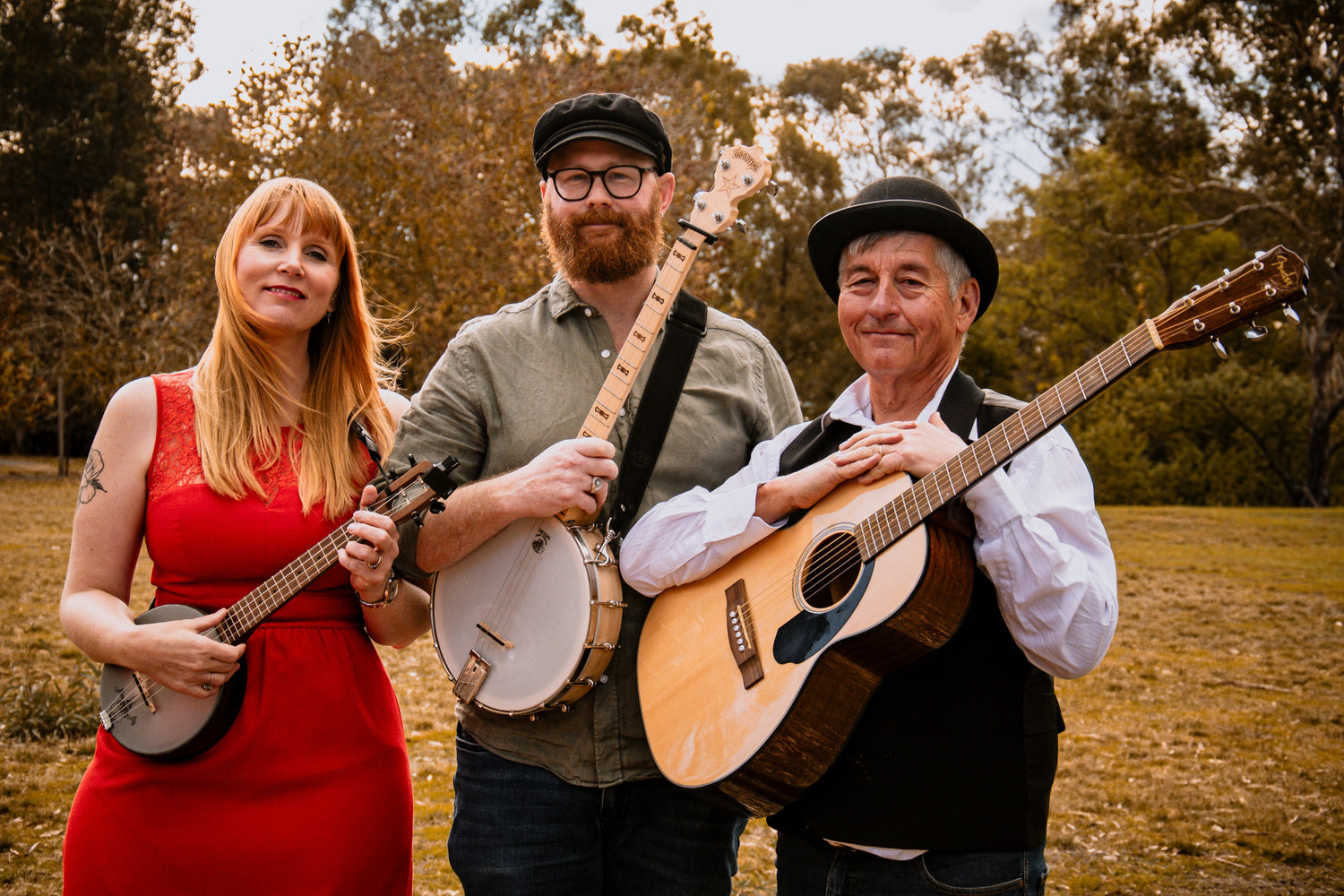
The Australian folk and bluegrass scene is about to get a serious injection of raw, unadulterated energy. Emerging from a chance encounter on a costumed Halloween night in 2023, The Runaway Strings have fast become one of the most compelling acoustic acts around. What started as a spontaneous front-porch banjo session between husband-and-wife duo Peter and Jiah and a wandering musician named Lionel has culminated in a magnificent debut record that beautifully captures the unpredictable magic of their origin story.
Their debut album, 'Blackwood', named after the forest and bushland surroundings of Greenhills Sound studio in Victoria, Australia, is an intimate yet raucous collection of tracks rooted in absolute authenticity. Recorded live, acoustic, and entirely in a single day, the record embraces the raw chemistry of musicians playing together in a room. Across the tracklist, expert musicianship meets sharp storytelling and an unmistakably human perspective, with each song standing as its own self-contained tale. The album exposes humour, heart, and truth in equal measure, navigating everything from the cynical grind of shift work to the bizarre struggles of modern independent artists.
We sat down with the band to chat about their magical beginnings, the thrill of high-stakes studio tracking, the inspirations behind their vivid characters, and the frustrations of making music in a digital world.
Hello and welcome! It is so wonderful to chat with you today, and a massive congratulations on the release of your debut album, ‘Blackwood’.
Your band’s origin story sounds like pure magic: a chance encounter on Halloween that brought Peter, Jiah, and Lionel together. Looking back at that spontaneous front-porch banjo session, how did you know in that moment that you had stumbled onto the right chemistry to form The Runaway Strings?
"I think anyone roaming the streets with a banjo ready to join in some kind of impromptu porch jam with a bloke dressed as a skeleton and a woman dressed as Frida Kahlo inherently brings the right energy to be part of The Runaway Strings. Straight away playing with Lionel, it just felt like he was the glue holding the tunes together, filling in the gaps, and we’ve just kept building on that."
You recorded ‘Blackwood’ entirely live, acoustic, and in just a single day to capture that raw, immediate energy. What were the biggest joys, and perhaps the unexpected challenges, of committing to such a fast-paced, "in-the-room" recording process?
"The thrill of doing it that way is that it feels inherently honest, and a bit of a tightrope act, you’re all feeding off each other and it has that great feeling that you get when you’re working together and you can’t tell where your instrument ends and someone else’s begins. The challenges are mainly technical around getting that nice clean sound of each instrument without too much bleed. Bobby spent a long time getting the room just right, but also then just learning to communicate with each other in the studio is a bit different. Because we play using a single mic type setup on stage, we are always pretty close to each other, but in the studio, having to be separated and still for the purpose of the mics, just made it feel a little different, but we got the hang of it."
The album is beautifully named after the forest and bushland surroundings of Blackwood, Victoria, where you recorded at Greenhills Sound. How do you feel that specific natural environment and geography seeped into the overall mood and sound of the record?
"We spent the morning on Bobby’s property at the Greenhills studio just soaking up the winter sunshine, chatting, warming up, rehearsing, and just enjoying the day. After we’d finished the album, and we got the masters, listening back we couldn’t really think what else we could call it. I think just that nice, relaxed, fun day was captured quite well, and so it seemed perfect. We also wanted to capture that in the cover art as well, which Julia did such a fantastic job of doing."
The songs of ‘Blackwood’ are populated by some incredibly vivid characters, from the sarcastic shift worker to the bitter pub musician. When you are writing, how do you approach building these personalities? Do they usually start from real-life observations, or do they completely take on a life of their own?
"A lot of the time it just starts from my own experience; I mean, I’ve definitely been a bitter pub musician before! But I like to take those experiences and then develop it to a slightly far-fetched place. Obviously, some of them I don’t have any experience of… Being a female pirate in the Caribbean, like in Stephanie the Pirate is not something I’ve ever done, but some of them are based on people I’ve met, Jimmy for example. I think what I try to do is then just pair a character that I’ve developed with a particular songwriting tradition, whether it’s a prison song like Goulburn Jail Blues or whether it’s the sort of bizarre outlaw tragedy of Jimmy."
Your songwriting manages to expose humour, heart, and truth in equal measure, often finding the absurdity in everyday frustrations. How do you strike that delicate balance between making a song deeply relatable and emotionally resonant while keeping that sharp, sarcastic wit intact?
"I think the balance comes from being specific with your songwriting. Comedians talk about being ultra specific in order to create jokes, but I think it’s true for any story telling. So Jimmy isn’t captured just anywhere, it’s outside Broken Hill. It’s not just “the cake recipe lied to me” it’s “Betty Crocker lied to me”. I think it’s those little details that make the song relatable and also witty. It helps you create that balance; without it the songs can just come off as sarcastic, which on its own is not endearing, they need to have relatable aspects to smooth out the irony."
The track ‘Come On Feel The Algorithm’ tackles the painfully modern frustration of trying to promote art under the gaze of tech giants. As independent musicians launching a debut album, what has your own relationship been like with navigating the digital world versus staying rooted in the authenticity of your music?
"I wrote that track after we had booked a gig in Melbourne. We’d played at this venue once before, did minimal online promotion, sold a few tickets, and did ok. They asked us a little while later to come back but asked us to follow a social media plan, post every day, blah blah blah, we did that and sold no tickets. It made no impact, and I realised at that point that with a lot of social media, you aren’t promoting your music, you’re just promoting someone else’s product."
"The song was born out of that frustration. We, musicians, are creating so much content for someone else’s business for such a minimal benefit, so it’s fair to say that the relationship is fraught. We don’t really write songs that feed into that, they don’t have 8-second hooks and they don’t really work for reels, which at the end of the day means our music won’t be as popular on those platforms, but that’s something I’m comfortable with. Good songs still spread, and the support we’ve received from community radio has been phenomenal."
Peter, you wore the producer's hat for this record, and you worked closely with Bobby Bravington on engineering/mixing and Nao Anzai on mastering. What did that collaborative dynamic look like, and how did you all work together to preserve that authentic sound in the final mix?
"I am not going to pretend that I am in any way a sound engineer or anything similar. Bobby and Nao are incredible and did a wonderful job of capturing the sound of the band. Bobby gently pushed us when he thought we had more to give and knew when we had the take and to move on. Most of our conversation was around understanding the way we wanted to capture the energy of the band, even if the takes weren’t “perfect”. The best of my knowledge with this is only to refer to other records, so I just kept telling Bobby I wanted it to sound like 'What Rhymes with Cars and Girls' and a few other classic records that get that great feeling of the band in the room, warts and all, and he got it. Nao’s mastering was just wonderful, and it just pops from the opening notes."
Now that ‘Blackwood’ is officially out in the world, these self-contained stories belong to the listeners. What are you most excited for audiences to experience when they dive into the album, and what is next on the horizon for The Runaway Strings?
"I am excited for listeners to connect with it in the same way that they do at our shows. It would be great to think that someone listen to it and think that they could do the same, write their own songs and record them. All my favourite albums are like that, inspired me to have a go. Being a folk band, there’s always the secret hope that someone will pick up their guitar, or their fiddle or banjo and take a song off the record to a festival and share it in a session or at the pub. The songs are easy! If you want the chords hit me up on socials! We are looking forward to getting some gigs booked in the near future, and then we’ve already started writing the second album."
It's clear that 'Blackwood' is just the opening chapter for a band that thrives on genuine human connection and the joy of shared musicianship. With a second album already in the works and upcoming live dates on the horizon, The Runaway Strings are proof that honest storytelling and raw acoustic chemistry will always find their audience, no matter what the digital gatekeepers think.
Make sure to support independent music and follow The Runaway Strings on Instagram and Facebook to check out upcoming gig dates and stay updated on their latest adventures.