
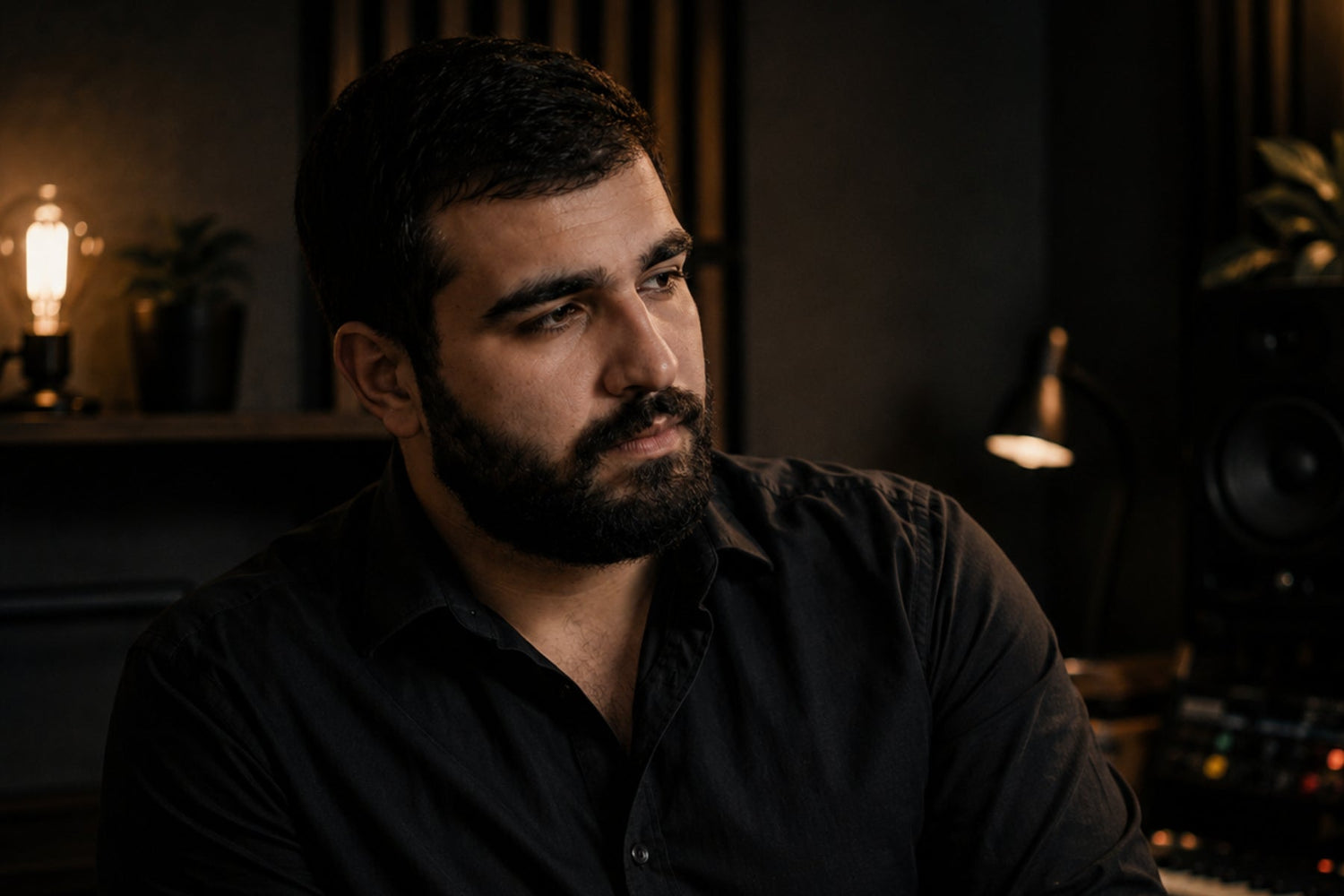
Malta-based composer and musician Serag Baddar operates in a unique creative realm, seamlessly merging heavy metal roots with expansive post-rock soundscapes. Viewing himself as a philosopher who happens to make music, Baddar crafts compositions anchored in emotion, accessibility, and genuine passion. Rather than chasing algorithmic trends, his philosophy centres on writing strictly for personal fulfillment and creative spark.
In this interview, we dive deep into the decade-and-a-half journey behind his latest single, 'Limerence'—a track originating from a teenage guitar riff that drew early inspiration from Buckethead and the clean interludes of bands like Opeth and Tool. We discuss his evolutionary shift from groove metal to post-rock, the freedom of treating music as a fulfilling hobby, and what lies ahead for his sound.
Thanks so much for joining us today, Serag! It’s a pleasure to have you here—how are you doing, and how does it feel to finally have ‘Limerence’ out in the world after such a long journey?
“Can’t stand the heat, but I’m doing fine, thank you. It feels like I’m finally close to closing a chapter. This chapter of building ‘Limerence’ took so long. The song has been with me as multiple iterations for so long I’ve gotten attached to it almost in its unfinished state, haha. Because so many versions of this song had things I wanted to keep but couldn’t. It feels like all those days are finally behind me now that the song is finished.”
You describe yourself as a philosopher who happens to be a musician, advocating for "writing for dopamine." How does this mindset shape your creative process compared to a traditional approach?
“The biggest difference between me and someone who writes traditionally is time. I take a really long time to get a song done because everything that I write has to make me feel like I’m listening to something from my favourite band. It’s difficult and time-consuming because you can only achieve this by working on sparks or what musicians call “the magic”—which is when you get a burst of creative energy and write great things without wanting to.”
You've mentioned that an artist doesn't have to sound like everyone else to create accessible music. How did you balance originality with accessibility while building the soundscape for the song?
“By writing for dopamine, working on sparks, and having progressive rock influences. Progressive rock bands like Opeth tend to write music without limits, so they provide quite a lot of inspiration with their music and can be varied. Not every song sounds the same, and every song has to sound different from the other. Having influences that push you to that standard helps in maintaining originality in accessible music. Working on sparks ensures that you make the best creative decisions with what you’re writing.”
The main seed for ‘Limerence’ was planted when you were a teenager trying to learn a guitar riff. Looking back, what was it about that initial idea that kept you coming back to it over a 15-year period?
“It’s a very nice riff. Unfortunately, it’s not as audible in the demo, but when the studio version comes out you’ll notice that it’s a really nice melody. Even the way it's played on the guitar—every note is placed conveniently where your hand can reach without having to stretch or move anywhere at all. For me, as a 15 or 16-year-old, writing that riff meant I had a melody that sounded professional, and I was very proud of that because at the time I really sucked at my instrument.”
Heavy metal and rock bands inspired you to take clean interlude sections and turn them into the primary foundation of your post-rock style. How did influences like Opeth, Tool, and Buckethead guide that transition from your early groove-metal roots?
“Opeth combines metal with clean riffs, especially inspired by 70s bands. I always wanted their clean sections to be entire songs, and from Opeth we only got one record like that, ‘Damnation’. Tool tread on the borderline of metal, but their melodies are also incredible on every instrument. Buckethead has amazing music; despite his large catalogue, he’s got some serious “accessible post-rock” gems like ‘A Real Diamond in the Rough’ and ‘Electric Tears’. It’s always through wanting more of this that kept me inspired to keep my distortion off and stay clean.”
‘Limerence’ carries a deeply personal theme. How did writing lyrics and vocal melodies late in the process help bring those hidden emotional layers to light?
“It was more about me trying to give something special to a person, because I have a deeply personal tie with the song itself in a way that has nothing to do with that person at all. I always considered ‘Limerence’ to be my baby. So naturally, the lyrics were going to end up being about me alone. I thought I could share this with someone special and have it completed because of them.”
Since you view music as a fulfilling hobby rather than a full-time career, how does that freedom affect the pressure—or lack thereof—that you feel when releasing new tracks?
“There’s no pressure at all. I do whatever I want and release material at my own pace, which is a great and necessary thing. If there was ever a demand, I wouldn’t be able to keep up with it because of the way that I write—on sparks. The freedom and lack of pressure is very good to me.”
Looking ahead, what can listeners expect as your sound continues to evolve from here?
“’Electric Smoke’ is more of a bluesy-sounding song, so listeners can expect less rhyming and perhaps a Kyuss kind of vibe. That’s the band that was on my mind when I wrote ‘Electric Smoke’. I think I’ll continue heading in that direction.”
How do you decide which old ideas deserve a second life versus starting completely from scratch?
“If a riff sounds good on its own and gives me a concept to work with, it’s good. It doesn’t mean it will fit into all my other ideas, and it doesn’t mean it should be scrapped if you have trouble writing follow-ups for it. That’s a golden rule for me. If it sounds very good on its own and makes you imagine an entire concept of how a song could be formed, it’s worth keeping.”
For readers listening to ‘Limerence’ for the first time, what is the best way for them to connect with your music and learn more?
You can listen to ‘Limerence’ on all streaming services, and you can purchase the single and read the lyrics on Bandcamp.”
It is clear that Serag Baddar’s patience and unyielding refusal to compromise his artistic standards have paid off in spades with the release of 'Limerence'. By allowing the music to develop organically over fifteen years rather than forcing a hasty completion, he has captured a rare, pristine moment of creative inspiration that bridges heavy technicality with deeply emotional, accessible melodies.
As he shifts his sights towards future projects like the blues-tinted 'Electric Smoke', Baddar continues to prove that writing purely for the joy of the craft yields the most resonant results. We look forward to seeing where his philosophical, spark-driven journey takes him next, and we encourage every listener to immerse themselves in the beautifully layered soundscapes he has built.
Make sure to follow Serag Baddar on Bandcamp and Spotify to stay up to date with his latest releases, upcoming projects, and behind-the-scenes creative insights!