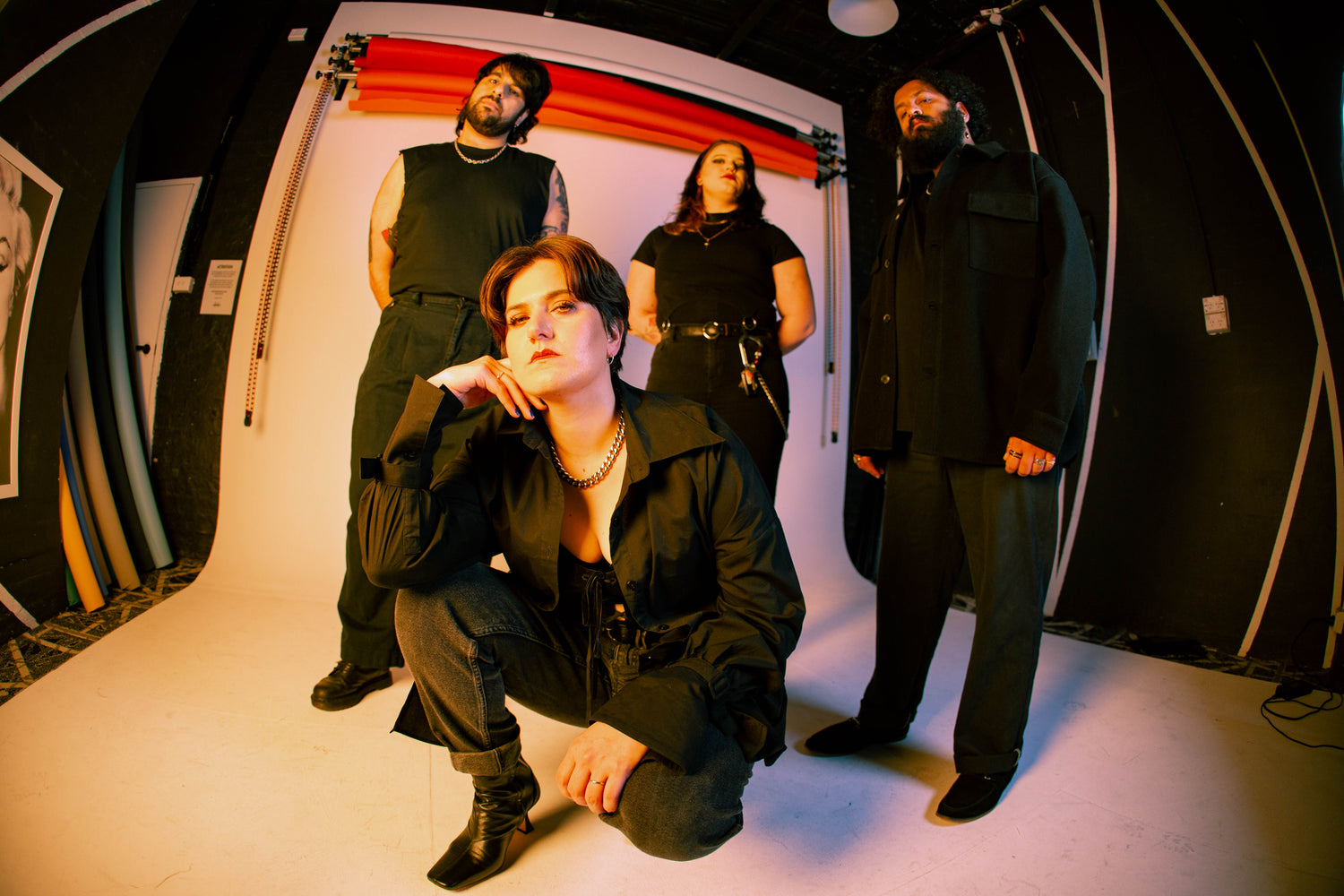
Emerging from Australia’s alternative scene with a roar, Second Idol have officially unleashed their debut album, 'Mongrel'. A record that feels both timely and timeless, it navigates the fractured landscape of a postmodern world, tackling everything from gender identity and postcolonialism to the raw sting of heartbreak. For a band comprised of second-generation Australians, the music is more than just a collection of tracks; it’s a consolidation of their values and a defiant celebration of complexity.
Building on the sonic foundations of innovators like Sonic Youth and Savages, the four-piece have crafted a sound that is as purposeful as it is powerful. While the album is available digitally via Gloomshift Records, the band’s commitment to the physical medium saw them turn to their community to bring the project to life on 12” vinyl. It’s an ambitious debut that proves Second Idol aren't just making noise—they're starting a vital conversation.
We sat down with Kate and the band as they shared the concepts, themes and musical influences that helped bring 'Mongrel' to life.
Kate (vocals/lyrics/guitars)
 90s and 00s alternative rock
"When I was writing material for the album and heading into the studio, I didn’t have a penultimate reference point or a singular artist that I intended to emulate. Yet there are influences that retrospectively, I see and acknowledge as being foundational to my sound and to Mongrel'."
"These influences are squarely in 90s and 00s alternative rock and include Smashing Pumpkins, Interpol, Sonic Youth, Placebo and PJ Harvey. In general, I have a real love of dissonant, moody and driving guitars, and I’m drawn to vocalists who have unique qualities and who are emotionally vulnerable yet eviscerating."
Embracing identity
"Before I became a musician and found my way into forming bands and gigging, I had a visual arts background. I worked in photomedia, and the main themes that underpinned my creative practice were based around family histories, my cross-cultural Scottish/Sri Lankan heritage and my rural upbringing in the NSW town of Kempsey on the Mid North Coast of New South Wales. Up to the point of writing material for 'Mongrel', this was something that I hadn’t explored in music. While I was jamming at home, mucking around with recording some guitar riffs, I ended up staring at an old photo of my Aunty and Grandad in Colombo, Sri Lanka in the 70s prior to the civil war. It’s a photo that my Mum took."
"My Grandad, Lorenzo, is behind a bar, and my Aunt, Christine, is perched on a stool, with a towel on her head and smoking a cigarette. My mum’s family from Sri Lanka is from the Burgher community, who are descendants of the Dutch and Portuguese who colonised Sri Lanka and intermarried with the locals from various ethnic communities. Their history is complex and intriguing. My mind drifted to wondering about a past time I could never know, my lineage, and about my existence now, as a biracial person and as an Australian. This contemplation on identity, my experiences with racism and notions of belonging permeated a couple of songs on the album, mainly 'Postcolonial Blues' and 'Third Culture Kids'."
Growing Pains: Imposter Syndrome & Self-Esteem
"Songwriting for this album stirred a lot of self-reflection on my childhood and teenage years in Kempsey. Growing up on Dunghutti Country was a huge privilege. It’s something that I’m really grateful for, I can’t imagine having grown up in the city! Despite this, it was at times quite lonely. I felt like I didn’t belong."
"The Macleay Valley is a beautiful part of the world, although it is a place where I was incredibly isolated once I hit my teenage years. I witnessed and experienced racism and navigated my closeted queerness in a conservative environment."
"There are a couple of songs on 'Mongrel' that tapped into the experiences and emotions that I experienced as a child and teenager, and out of these experiences emerged contemplations on self-esteem and imposter syndrome, which I’ve grappled with through to adulthood. These themes make their way into the songs 'Little Girl' and 'Silicone Maggot', both of which are vastly different sonically."
'Silicone Maggot' is the opening track to the album; it’s a grungy epic song that veers into jammy shoegaze-esque riffs. It head-on tackles imposter syndrome, and the anxiety one can feel when you walk into a room, you feel sick in your stomach, when you feel like you’re not good enough, and you don’t belong. It’s about reclaiming your power, your worth and your seat at the table."
"'Little Girl' is about self-worth, finding your truth and navigating gender."
Gender & Femininity
"I’ve always been critical of gender conformity and the boundaries and restrictions that societies place on women. While this is a common thread in my lyrics and songwriting, it’s overt in two songs on the album, 'Boxing Ring' and 'Little Girl'."
"'Boxing Ring', is a rock song that critiques biases within the music industry and the experience of being a non-cis man in a male-dominated world. It’s born from my experiences and observations in music and the double standards the women, non-binary and trans musicians are held to, whereby we’re equally placed on a pedestal, yet at the same time novelised, pitted against each other and cut down."
"'Little Girl' is a far more delicate take on gender. I position it as being a letter to my childhood self and a contemplation on innocence, identity and constructs of femininity. When I was writing Little Girl, I started thinking about how my life was when I was 5 years old – the innocence I had, what I liked to do, what my favourite trinkets were, what I liked to wear, what made me happy. It’s a real reflection on girlhood escapism, the wounded child and reconciling with notions of femininity."
The word ‘Mongrel’
"I had been fascinated with the word ‘mongrel’ for a while, and with its different usages, how it can be seen as an insult, a very Australian term and disruptive – a rejection of conformity, purity and binaries and clear definition, a mixture of backgrounds, a loveable working dog, a mutt, an insult, then resilience. It’s a word that has multiple and deep meanings. I’ve referred to myself as a mongrel for a while. Hell, those who know me well will know that I’ve had the word as part of my instagram handle for years."
"The use of ‘Mongrel’ in this album emerged when I was writing 'Postcolonial Blues'. I was contemplating my biracial heritage, and particularly my Eurasian heritage from the Burgher community in Sri Lanka. I got thinking about postcolonial literature that I’d read, including 'Cereus Blooms at Night' by Shani Mootoo and 'Running in the Family' by Michael Ondaatje. While I was thinking about diaspora and belonging, as well as feelings of ostracism and exclusion, I wrote the lyric ‘another mongrel coming through’. This lyric and the word ‘mongrel’ continued to echo with me, and just followed me through writing the rest of the album."
Placebo ‘Never Let Me Go’
"Placebo is a band that shaped me as a teenager, and one of the bands that helped me realise that I was queer and bi, and they opened me up to a dark, sexy and dangerous alternate universe where gender conformity was optional and challenging the status quo was encouraged. Placebo’s eighth album 'Never Let Me Go' came out a couple of years before we headed into the studio. This record really stuck with me, mainly through their raw emotional lyrics that are brutal in their honesty, particularly the song 'Fix Yourself'. Subconsciously, this album was carried through with me, along with my general love of Placebo."
Sunny (guitars)

The imagery
"For 'Mongrel', I was drawn to old Western and Victorian gothic imagery, evoking desolate landscapes, moral decay, and a constant sense of impending doom. That atmosphere informed the emotional backdrop of the record and shaped how tension and unease sit beneath the songs. Akin to a scene from an old cowboy film where a mysterious stranger enters a small hot desert town on a pale horse as the villagers scatter and retreat, shop owners close their storefronts, and silent, judgmental eyes watch his every move from behind drawn curtains."
Fath No More ‘Midlife Crisis’
"Faith No More’s 'Midlife Crisis' was a key reference point, particularly in how tension, restraint, and repetition can feel heavier and more confrontational than excess. That balance between groove and discomfort became an important guide when shaping the guitar parts across the record."
Anti-tradition
"I made a conscious decision to omit the traditional guitar solo as a way of breaking from expectation and inherited norms. Instead, I focused on simply written bridges and outros that hit emotionally, using space, repetition, and tone to support the songs and reinforce 'Mongrel’s broader themes of resistance, discomfort, and non-conformity."
Theia (bass)

Dissonance/Disparity
"For 'Mongrel', I really wanted to channel the dissonance and disparity of our modern world in a similar way to post-Cold War Post-punk. Dark, moody, existential throbbing sounds and basslines with just enough punch to hear over the ringing of the doomsday clock. This really came through in Postcolonial Blues, where the bass is almost a dread march that then dives into noise and bends while the rest of the instruments stay steady. Rug pulling and uncertainty."
Nine Inch Nails' ‘Only’
"This song in particular was a standout influence for me, a combination of crunch and grit with pop grooves and octaves. This song inspired the bass for 'Spineless Wonders' in particular. In contrast to the iciness of the verses, it can be heard in the choruses. I strive to make creations that are marriages of fairly separate influences, and 'Only' was a great example to learn from."
Simplicity
"'Mongrel' was a learning and therapeutic experience for me. I’ve always had a bit of an inferiority complex as a bassist. I’ve never learnt how to slap, and I'm not particularly fast with scales or multi-string endeavours either (both are things I’m bombarded with online). So with 'Silicone Maggot' there was a massive intention to fight that feeling by being intentional with my notes and to do as little as possible. 'Silicone' in particular ended up being an incredibly strong track and, internally, has helped me solidify my own progress and skill."
Afeef (drums)

Title Fight ‘Hyperview’
"'Title Fight' has been on heavy rotation for me since my high school years and will always continue to be a massive influence on my songwriting. Sometimes mellow, sometimes lacerating, sometimes a strange combination of the two, and you can never guess which one they will be. A band who, unfortunately, will always remain an enigma to me, as they are no longer active, but their music lives on forever through my car speakers and when I subject the band to my playlist for multiple hours when driving between cities on tour."
"Looking back on this album, it’s really hard to point out what my influences were because I feel like the drummer I was when I first started writing this album is very different to the drummer I became at the end of the writing process. I’ve always been a fan of high-energy rock, hardcore and rap, as a result, my drumming was really just me trying to fit as many notes and hits as possible into any section I could. This is super visible in the chorus of tracks like 'Third Culture Kids' and 'Boxing Ring' where, while the parts are still good and I have no regrets, there’s a lot going on and it's really just me trying to flex. Whereas songs we wrote later, like 'The Harbinger' and 'Little Girl', were more rhythmic and were drawn from a place of being more introspective with a rhythmic backbone and giving more space for the lyrical messages to be conveyed. 'Spineless Wonders' and 'Silicone Maggot' serve as this little middle ground between my playing styles, which gives more room for the rest of the instruments and lyrics to breathe."
With the successful birth of 'Mongrel', Second Idol have cemented themselves as a band that isn't afraid to lean into the "mongrel" nature of identity. By embracing their diverse backgrounds and the friction of the modern world, they have created a record that serves as a beacon for anyone feeling isolated in the digital age. As they continue to carry the torch for bold, innovative rock, one thing is certain: they have found their audience, and their audience has found a voice.
You can stream the new album today or grab a copy on vinyl from Second Idol's Bandcamp page. You can also catch the band on their upcoming tour through Victoria, New South Wales, and Queensland this March, including shows at the Cactus Room, the Chippendale Hotel, and Society City. For all dates and tickets, head to the band's website here. For more, be sure to connect with Second Idol on Facebook, Instagram, and TikTok.