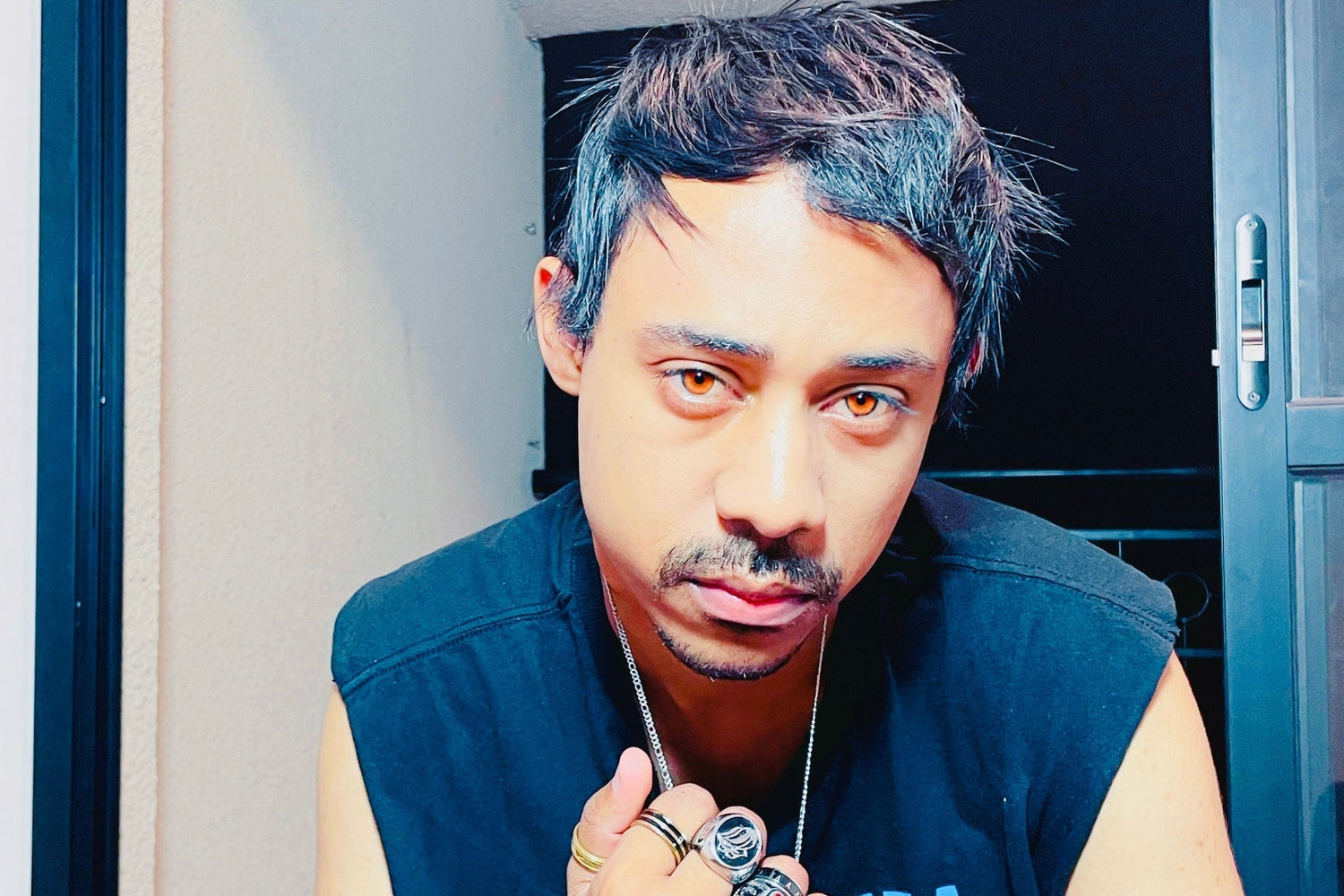
Five years after the release of his first album, model and musician Saulo Oliveira S., known as the “Prince of Rock,” returns to the music scene with an album that offers a commendable balance of attractive melodies and reflective lyrics, set to his own lore. A seminal return to the spotlight, ‘Do Gears Know They Are Gears?’, released on December 4th, 2025, has garnered praise worldwide, including in recent editorials in France and Germany.
The international acclaim is well deserved. Through the album, the singer-songwriter is free of external labels and follows his own intuition and audacity in not limiting himself to consensus, making the best creative choices that are in line with his vision of narrative, enhancing the atmosphere of the 8-track project. The result of this is a Saulo Oliveira with a remarkable musical maturity delivering a refined work in detail that enriches it and confirms the promise of the British Brazilian creative powerhouse.
Part of the appeal and charm of the album can be attributed to the fact that there is no harmonica solo in this chapter of Saulo’s story, and, curiously, the absence of the mystical instrument "Elder Harmonica" is not felt. The project is satisfied with the self-sufficient greatness of the internal narrative and dispenses with the addition of other elements other than those already there. There is the famous story around the "Elder Harmonica", where Saulo received it at a crossroads, still 12 years old, from the devil himself. This story brough Saulo to the attention of an online community and generated in him, probably unconsciously, a certain sense of indispensability about the harmonica appearing in his musical works.
That said, part of the joy of his sophomore album lies in the eloquent silence of the famous harmonica that, left aside this time, proves the maturation of the artist's creative choices and confirms his purpose of freeing himself from the pigeonhole of being “The Boy Who Defeated the Devil and Became Bigger Than God.” In this record, he’s finally letting go of the folklore.
The other part of the appeal, obviously, concerns everything that is there. The awakening message followed by a cinematic collage in the opening monologue, smooth transitions between songs, the Pythagorean musical scale of ‘Middle Finger’ (in terms of medieval thinking, fifth-based interval hierarchy and mechanical tension), ‘Hilltop’ shines with well-allocated synthesizer that turns out to be a mesmerizing pop synthwave, the vocals adjusted with cadence, the piano arpeggio in ‘Maze’ and, finally, supporting everything, a plot worthy of the Oscar for best screenplay.
There are many multi-layered messages in the songs. Each sentence means something that is related to something in some other corner of the album and the chord used to denote a circumstance at a given time will be the same that will recall such a circumstance when the narrative cycle is raising the full circle. It is an exercise in intelligence of the purest dedication, competence and erudition. ‘Do Gears Know They Are Gears?’ is intelligence crystallised by a rigour that justifies having taken years to come out, since Saulo does everything by himself.
It is in this rigour that ‘Do Gears Know They Are Gears?’ finds its power. The album is at once a return and a rebirth: a sophomore effort that surpasses the promise of Saulo’s earlier work, establishing him not merely as a talented musician but as a thinker whose music inhabits the interstices between rock tradition, philosophical inquiry, and contemporary culture.
In its scope and internal coherence, ‘Do Gears Know They Are Gears?’ belongs to the rare company of twenty-first-century albums that feel not merely successful in numbers, but, which is more complete. Like Lana Del Rey’s ‘Norman Fucking Rockwell!’, Frank Ocean’s ‘Blonde’, and Billie Eilish’s ‘When We All Fall Asleep, Where Do We Go?’, Saulo’s sophomore work achieves a level of wholeness that transcends individual tracks.
Saulo’s album shares that quality of inevitability — the sense that nothing could be removed, rearranged, or diluted without diminishing the whole — marking it as one of the defining masterpieces of the century, alongside its peers.
So, we caught up with the artist behind it all to discuss the process, the album, and the folklore he’s leaving behind.
Thanks for joining us today! It's great that you have new material for the world to talk about. Your songs have been called a mixture of Jim Morrison and Kurt Cobain. What guided the themes of this album, which looks like an introspection exercise of an old soul?
“Thanks for having me. One day I got impressed with the lyrical approach of ‘An American Prayer’, Jim Morrison's album. The idea of spoken words permeating a complete album seemed attractive to me. So, for a long time, I kept the idea of writing a monologue as effusive as other great texts in the history of music and cinema. In this process, I analysed, for instance, the cadence and internal coherence of ‘A Feast of Friends’, David Bowie's speech "Time... one of the most complex expressions...", Baz Luhrmann's ‘Sunscreen Song’, and I really like Miley Cyrus' latest ‘Prelude’.”
“I also like Rocky Balboa's inspiring monologue about winning and losing, in the 2006 film, Chaplin's warning speech at the end of The Great Dictator or Blade Runner's ‘Tears in the Rain’. Each of these texts has an idiosyncratic relevance, its own energy, something that I tried to evoke for the opening of the album. Soon, that text expanded and allowed the theme to be explored in other songs, from other angles. So, I had the main concept of everything: the passage of time, surveillance, the feeling that reality is false and the need to awaken and escape from the mediocrity of a cyclical and purposeless existence, to stop being just another gear in the machine.”
What’s the most important thing for you when you’re writing a song?
“Coherence. In the sense that every narrative has an internal logic that once started it should not betray itself or its own atmosphere.”
How does the fact of having independent control of what you want to do find harmony with the awareness of the correct creative choice to achieve the best result in the absence of a second opinion? What is the best part of this freedom?
“Being able to make decisions at all stages of the conception of a musical project is always challenging. The responsibility for the result is exclusively mine. If I decide to build a story and, as a way to it, I choose that two of the songs will be narrated in a spoken way, I have to be prepared for the risk of estrangement of those who are on the other side and eventually wonder ‘What's going on? Why is this so talkative? Where is the singing in this?’. And, on the other hand, if it makes sense and people are interested, the consequences should also fall solely on me.”
“Not relying on the filter of an external opinion can be liberating because it frees you from the deprivation of your idealised vision. Everything that reaches streaming is the product of my pure and unreserved vision. Particularly, I don't miss what could have been the voice of some producer saying those screams of pigs at slaughter or someone under torture in ‘What Governs Behind Them?’ and ‘Kool Kids Klub’ were unnecessary or that there is an excess of harmonica in other works. The best part is the possibility of following any path.”
There’s been a lot of talk around the album - could you give us the undisputed truth of the way the protagonist gets it from Heathcliff’s mouth? Plus, tell us if all that happened was real or a dream?
“The outcome of the album is ambiguous in a purposeful way, an interpretation of mine would now remove the relevance of the particular interpretation of each one who listens. The idea is that the protagonist himself is so immersed in his own questions that he no longer believes that even a simple object, a glass of lemonade, next to his bed, is just a glass of lemonade. There is a theory that certain particles of matter, at the quantum level, when observed, behave differently, then, we could be living as if in a video game in which the scenario only appears when the character is moving and interacting with the environment. The question, therefore, transcends whether he dreamed everything or not.”
Although he said the “dream has dreamt itself”?
“The character said lots of things and went through plenty of others that could mean anything. After starting the journey, disturbed about the essence of existence, the protagonist ends up not being able to distinguish whether the acidity or the sweetening of the drink was designed to be that way. This echoes John Fowles’s ‘The Magus’, a story about someone incapable of distinguishing reality from imaginary. But what if he knows the difference and doesn't want to say it because Heathcliff's answer may have inclined him to capitulate with the machine and let the listener continue in the darkness of ignorance?”
“Is that why he said it was always lemonade? Could it be because he is trying to convince us that reality is not simulated? Or was Heathcliff's answer not enough to solve all the issues and he actually doesn't know? Or was this reality always this reality and period? Or, by saying that it was never lemonade, does he mean that the reality is indeed false and the answer obtained allowed him to see that he was right from the beginning? By saying that the dream dreamt itself, is he implying that our reality is self-generated as in the Big Bang theory or that he has been lying in that bed since the beginning, for so long that he doesn't even remember if he's dreaming and which dream is inside which?”
“How does the experience of having died after hearing the answer and having been the only one in history to return from death with the power of such wisdom influence the apparently intentional chosen ambiguous tone of the final monologue? What did he see on the other side? Why does he start in half-light and also end in half-light? Wasn't the experience of the journey and getting the answer enough to make him completely enlightened? Or was it? and he's bluffing, keeping the information to himself because the listener wouldn't handle the truth?”
You are known as being one of those people that you can look in the eyes and inevitably get a feeling that you know all the answers and have all the keys to all the doors. How does this aura position you in all the symbolism you’ve been cultivating along your particular journey?
“All in all, the journey depicted in the album is not necessarily mine. The perception that everyone lives in a loop like zombies in a lifeless and grey routine, in a simulated reality, and that it is necessary to find the way out of this maze translates a universal feeling with which anyone can identify. The metaphor of getting out of the maze can serve for the relationship that no longer works and from which two people need to free themselves, for the job that corrodes you inside, and so on.”
“I have used many symbols in recent years, the cover of my previous EP has my eye in the centre of an image denoting a specific message. And in this album, the triangle was chosen because it is the delta in the Greek alphabet, which means change or variation. Maybe I have the answers, but I wouldn't say. If I have a concept about life, the universe and everything else, if I unravel this formula for you, it won't make sense because it applies to me. So, it is what it is and it ain’t what it ain’t.”
In other words, “It was never lemonade, it was always lemonade”.
“Precisely.”
What’s next for you as an artist? What’s the plan for 2026?
“I’m open to opportunities. Looking forward to good partnerships. The future is an uncharted terrain. My main goal for 2026 is to get to 2027.”