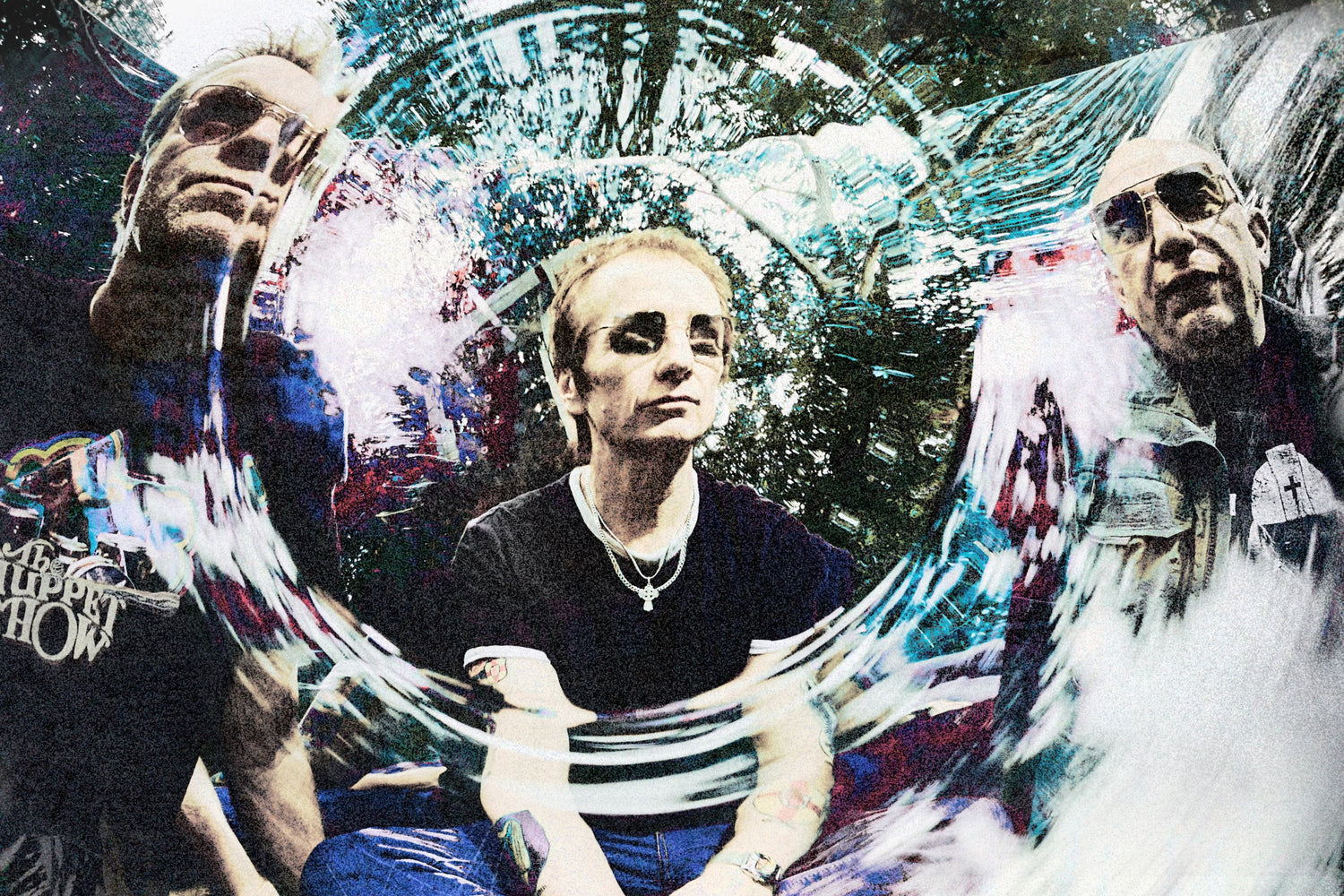
Perth’s own purveyors of heavy psychedelic sorcery, Monotonic, have finally unleashed their long-awaited debut album, 'Heavy Metal'. Released via the revered Australian label Hidden Shoal and under the guidance of label head Cam Merton, the record is available now, including a limited vinyl run for the purists. The album represents the culmination of a singular vision—an exercise in mind-altering sonic experimentation that feels like a one-way journey to the outer reaches of the galaxy.
Across eight tracks, 'Heavy Metal' delivers a masterclass in psych-rock minimalism, where hypnotic repetition and thick distortion blur the lines between groove and atmosphere. It is a heady fusion of early ’70s dub, space rock, and acid rock, underpinned by a motorik pulse. Formed during the pandemic by veterans of Perth’s golden alt-rock era—Liam Coffey (Header), Allan Balmont (Ammonia), and Jack Lucas (Yummy Fur/Six Mile High)—the trio has traded their '90s roots for something far more lysergic.
In this interview, we dive into the band's transition from casual jams to a cohesive record, the influence of legendary dub producers, and the prestigious mastering process at Abbey Road.
A very warm welcome to you all, and congratulations on the release! Given your collective history in Perth’s alt-rock scene, how did it feel to step back into a rehearsal room together after all these years, and at what point did you realise these jams were evolving into a full-length album?
"When we first jammed together, probably early 2023, it was literally just for a bit of fun, with literally zero ambition to make anything vaguely serious about it – we just each nominated five or six covers we wanted to have a crack at, and it ended up being an oddly eclectic list, but an absolute blast to play: Jimi Hendrix, Joy Division, Teenage Fanclub, T.Rex, Screaming Trees, Happy Mondays. But once we started just jamming freely on our own riffs, it was clear pretty much straightaway that somehow, without trying, we’d stumbled onto a distinct sound that we hadn’t even been looking for."
When you were in the studio at Aerial Recording, what kind of headspace or physical environment were you trying to manifest through your instruments and your unique recording process?
"The method we used was to start from the most basic bass or guitar riffs, with one or two changes at the very most for each track, and literally construct them in layers from the ground up. We started with just drums and bass, 10 or 12 tracks (eventually whittled down to eight for the record) of just grooving on a single riff for about 15 minutes each, and subsequently cutting and pasting the best of them into song-length arrangements."
Liam, you’ve mentioned an ambition to make the record “compositionally minimal” but “sound-wise unrefined”. What is it about that friction between simple structures and obnoxious textures that appeals to your creative sensibilities?
"It’s that appealing aesthetic in music of paring everything back as closely as possible to some sort of essence and discarding anything surplus to requirements, while retaining the sort of unrefined, unruly, unapologetic raucousness that characterised 1970s punk, late 60s freakbeat and acid rock and even the original 1950s rock and roll. Somehow disciplined but seditious and riotous at the same time, like the Ramones' debut album or, in a very different way, Kraftwerk’s Die Mensch-Maschine."
The album title, 'Heavy Metal', definitely plays with genre expectations. How do you feel that title reflects the actual sonic weight and aesthetic of the music rather than the typical genre tropes?
"It’s just such a cool term as a genre name, albeit a term that since the mid-70s has consistently promised more than the genre’s delivered. Obviously that’s an entirely subjective view. It just seemed like Black Sabbath somehow appeared fully formed in 1970 with a sound that, to my knowledge, didn’t really have any precedent, and that’s impressive. But really, it’s just about that term, stripped of its generic connotations, and what it could potentially have been a descriptor of."
With the vocals functioning as a “fourth instrument” drenched in delay and distortion, how do you approach writing so they serve the atmosphere rather than traditional song craft?
"That idea is literally lifted wholesale – or stolen, if you like – from the remixing techniques of the genius Dub producers of the early 70s that I really fucking love, like Lee Perry, King Tubby, Scientist and Mad Professor. It turned out – I hadn’t realised before we went there - that Ronan Charles, the owner/engineer at Aerial Studios, actually had an original Roland Space Echo unit there! So that just seemed like some sort of cosmic serenity. I’ve just always really dug the fact that the original Dub versions were more about creating a very particular kind of mind space and atmosphere, with severely edited vocal tracks buried in reverb and delay, than they were about privileging lyrics and vocals in a kind of narrow, prescriptive and limiting way."
Working with Frank Arkwright at Abbey Road adds a prestigious final touch to the record. How did his history with iconic bands like Joy Division and Mogwai align with the sound you were chasing?
"We were extraordinarily privileged to have the album mastered by Frank, who’s literally a mastering legend with a frankly astonishing CV. Obviously Joy Division was one of the major deciding factors in seeking out his services, but I’d say equally his work with Roxy Music, The Smiths and, especially, The Verve’s 1995 album, A Northern Soul."
You’ve expressed a desire for the album to be a cohesive, linear experience rather than a collection of singles. In an era of digital playlists, why was it important for you to go this route?
"We all grew up in an era when it was literally an event when your favourite artists released a new LP, because from the late 60s until, arguably, the mid-90s, vinyl albums at their best were bona fide immersive works of art that you could literally get lost in. Graham Hughes’ art direction for the original 1973 cover and inserts for The Who’s Quadrophenia – not the 1979 film soundtrack – was, and still is, utterly sublime, and I guess it’s that sort of immersive experience that we’d hope to extend to the actual recording."
"To say we’d hope it to be a cohesive experience is certainly not for a second to suggest it’s a ‘concept’ album, because it’s absolutely not that in a narrative sense, but more that if it’s able to sustain, all the way through, a consistent atmosphere/ambience/tonal character for whoever’s listening to it, then mission accomplished."
It is rare to find a debut that feels so seasoned yet so experimental, but Monotonic have managed to bottle the lightning of their collective experience into something genuinely transportive. Whether you are spinning the limited vinyl or streaming it into the ether, Heavy Metal demands—and earns—your full attention.
For more, be sure to follow Monotonic on Instagram and Facebook.