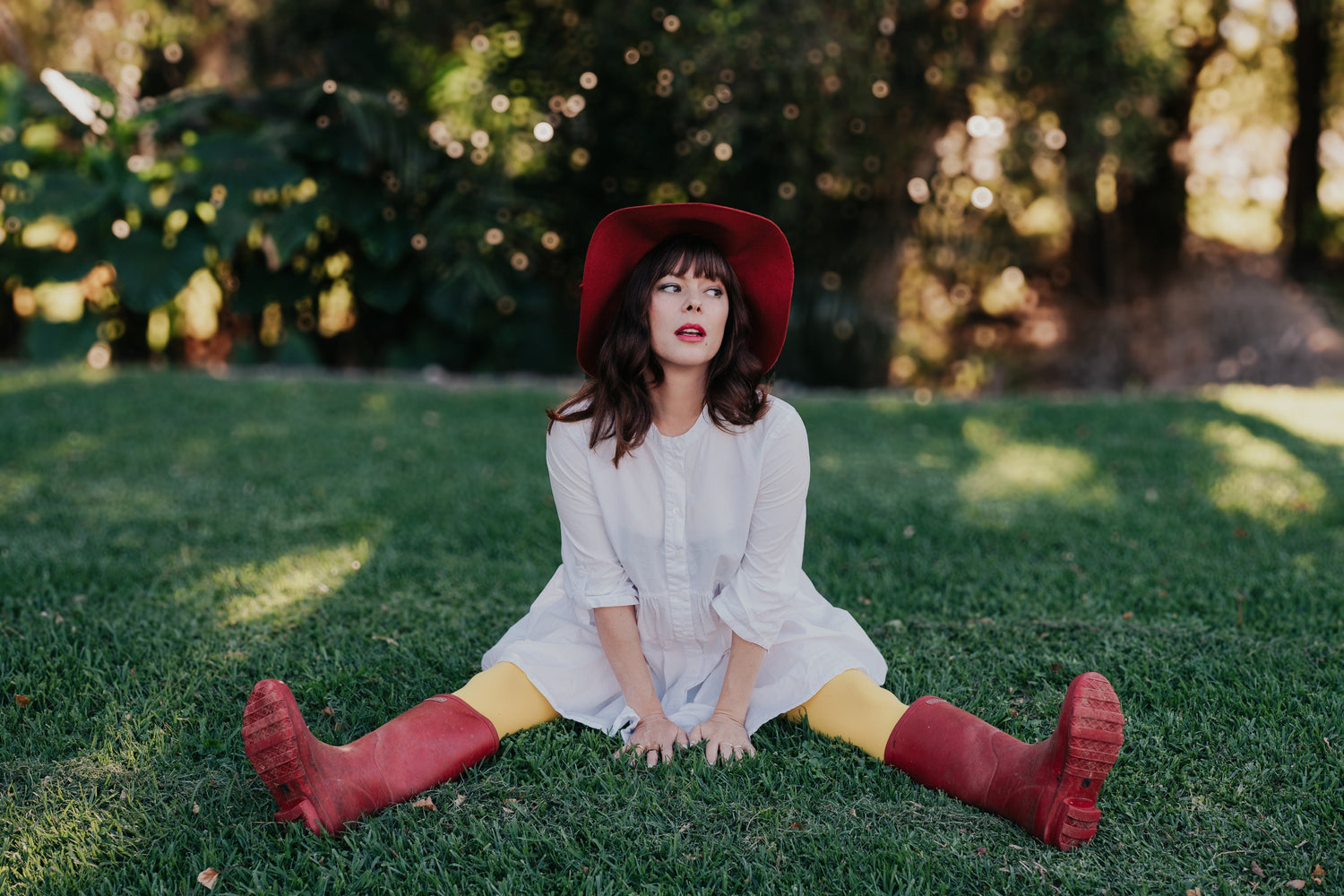
Lenka has always possessed a knack for turning internal monologues into universal anthems, and her latest offering proves she hasn’t lost that whimsical touch. The Australian singer-songwriter has just unveiled the title track of her upcoming record, ‘Good Days’, which serves as a vibrant precursor to the full album arriving on 29 May via Skipalong Records. This isn’t just another pop song; it’s an intentional manifestation of peace, serving as the heart of a ten-song collection that navigates the complexities of modern womanhood with a vintage lens.
To capture this specific aesthetic, Lenka teamed up with producer Tony Buchen in Sydney to craft a soul-revival atmosphere that shuns over-processed digital trends in favour of rich, organic arrangements. From the soulful warmth of the opener ‘Sunshine Girl’ to the collaborative closing track ‘The Balance’, the album feels like a cohesive remedy for a chaotic world. It’s a grounded, authentic evolution for an artist who first captured our collective imagination with hits like ‘The Show’ and ‘Everything At Once’. Sydney fans can experience the new material in person on 25 June, when Lenka takes over The Vanguard in Newtown for a special full-band launch show.
We caught up with Lenka to chat about the new album, stepping into the studio with live musicians, and her twenty-year musical journey.
Hi Lenka, thank you so much for joining us today! As your seventh studio album celebrating two decades of an incredible independent career, how does it feel to reach this milestone, and does this record feel like a return to your classic sound?
"It does feel like a bit of a milestone, though every time you put out an album, it feels like that'll be it forever – like, I quit, I'm never doing it again! Then I go through this process where I start writing songs again, think, oh okay, maybe I'm collecting some nice ones, and I get really excited and go through the whole cycle again."
"This one actually feels a little like a return to the sound of my first album – very influenced by '60s soul-pop, the Beatles, the Zombies, that kind of thing. I was trying to get back to the essence of a classic Lenka song because often across those eight albums I've been experimenting with different tangents. So this one feels like coming back to my classic sound."
What was it like stepping into the studio with producer Tony Buchen to record with live musicians, and how did that human warmth shape the energy of these songs?
"It was an absolute pleasure – I was just like a pig in mud, lying on the couch, having the best time. It's an honour and a privilege to be in a situation like that."
"I sort of feel like a director in a way. I've written the songs; I've got a vision; I've given a few cues about what the vibe should be, what the genre is. Then Tony is really great at curating the right musicians for the project and dialling in the sound – the gear is quite retro and old, which is exactly what we wanted. And then you just let go and let excellent musicians do their thing. You try to do as few takes as possible, keep the realness of it, embrace some imperfections – however it landed is how it landed.
"Especially with vocals, there were fewer takes, less stacking, less editing. Just singing the whole song and letting what will be, will be. It's a rare way of doing things these days, and that's exactly why I wanted to do it. It feels really special and really human – getting that warmth and those imperfections is actually a real treat. Anyone can make anything with computers now, but to get the essence of a human being pouring themselves into the playing of the music is something special."
Songs like 'Mettle' touch on deeply private events, such as your husband's serious bicycle accident. How do you approach transforming such raw, real-life vulnerability into a poetic metaphor?
"I try to make it a little vague and poetic. Being too literal feels nerve-wracking, though I don't mind that so much – I'm a bit of an exhibitionist, and I'm a very honest person, and I'm quite happy to share personal experiences. But I'm really conscious of where it's going to land and how it communicates, because I think about my own experience as a music listener and a fan. I loved listening to Björk when I was a teenager and trying to place what she was saying into my own life."
"With 'Mettle' specifically, it's my reaction to my husband's experience – and mine as his partner – during eight days in hospital after a serious bicycle accident, with metal put into his body and his jaw wired shut for two months. I felt I had to let something out about it, so I channelled that emotional outpouring into the song. But it's a poetic metaphor: metal as a symbol of strength and resilience, of seeing him have to dig deep and find that inner toughness. So there are a few descriptions of real things, but it's also something bigger."
"Ultimately it's about turning life into a piece of art. I'm not a diary-entry type of artist – I want to make an artistic version of life because I personally find that more interesting. And I want listeners to be able to relate. We've all got different experiences, but we're all human, and the human condition has a lot of overlap. Even if someone's situation is different, there will be triggers they can recognise and hopefully messages that feel helpful."
You've described 'Good Days' as a 'spell and a wish' for the world. What are your main hopes for listeners, and how does this project tie into your current feeling of 'defiant optimism'?
"I'm feeling a sort of defiant optimism at the moment. It's so easy to get down about the world – I do frequently get very frustrated and despondent about what's going on – and it's heartbreaking. But I really believe in the power of positivity, and it almost feels like a 'fuck you' to the system to still believe in the good things. To still strive to make your life wonderful, to walk outside and appreciate the goodness of existence, and to push that out to the people around you and create your own little slice of joy."
"At this particular moment in history, that almost feels like the rebellion. And the simpler you can do it – the less you need to consume or spend – the bigger the statement. Partly it's for my own sanity, but it is a little bit of a manifesto of defiance."
For the album closer, 'The Balance,' you collaborated with your international fanbase to gather words about joy and hardships. What surprised you about their responses, and how did you use AI and your own tailoring to weave them into the track?
"I think I was more surprised by the negative words than the positive ones. The positive ones were lovely – so many of them, and often not surprising. Things like rainbows, ocean breeze, baby smell (which I loved – we all love baby smell, but you wouldn't instantly think of it!), cold beer. I tried to weave in as many as I could from all different points of view."
"But the negative words were milder than I expected. Things like torn clothes and allergies – they weren't devastating at all. I wonder if it's because my fanbase is similar to me: people who strive for joy and try to find the light. There wasn't a massive outpouring of frustration. I got far fewer negative words than positive ones, and I'm going to take that as a good sign for the human race."
"As for the process – I copied all the words into a document and asked ChatGPT to put them into rhyming stanzas, which was great for the heavy lifting. Though honestly, it wasn't amazing – there were some good things, and then it started asking if I wanted it to write the whole song, suggesting different genres, and I had to say, okay, stop, back off! I ended up tailoring most of it myself. The key was choosing words that sing well, that feel good in the mouth. Some words are just terrible to sing. So if anyone's word didn't make it in, that's the only reason – it was either a question of length, or it just wasn't going to come out of my mouth the way I needed it to."
The track 'So Far So Good' explores oracles and gratitude. Looking back at your journey and the clairvoyant who predicted your massive global success with 'Everything at Once,' how has your perspective on fate evolved?
"I think about this a lot. What has shaped my journey? Why has it gone the way it has?"
"I can't help thinking about when I visited a clairvoyant – an astrologer – around my 30th birthday, right when my first album came out. My manager bought me an astrology session with this wizardy lady out in the desert in California. She told me my height of fame would be around 34 or 35, and that it would have something to do with flickering light. Looking back, that was exactly when I had the Windows 8 campaign for 'Everything at Once.' It wasn't big in Australia, America, or the UK, but it was huge in other markets – India, China, Germany, Russia, Poland, Turkey – and it went to number one in a lot of those countries. And the flickering light? Well, that's what it looks like on a screen. So thinking about the sheer number of people who saw my face and heard my voice during that campaign... that was probably the most famous I'll ever be in terms of raw eyeballs. I didn't get to fully experience it, but I take that kind of thing with a grain of salt while still sort of believing in it."
"I do lean into the woo-woo a little. It helps me stay positive when looking back – to not gripe and instead go, well, so far so good.' I'm doing okay. All the bad times have added up to where I am now, and things are alright. That's a helpful frame for getting through the harder stretches."
You've built an incredibly dedicated global audience whilst maintaining a fiercely independent career. How do you navigate the line between artist and content creator, and how does your fanbase support you?
"It's genuinely challenging. There are varying sizes of fanbases across so many territories, and I can't focus on just one – they all come from such different cultures. Occasionally I try to tailor communications for specific audiences, but mostly the best approach I've found is to just authentically be myself, put out the work I feel like making, and hope people connect with it. There's no way to reach everyone correctly."
"I'm trying to be better on social media – making content as much as I can without feeling like I'm sacrificing my integrity as an artist. There's this really strange, wobbly line between being an artist and being a content creator these days. I probably would have been a content creator if it had existed when I was a teenager – I don't mind the platforms themselves. But now I'm really only on them to support the music, and I try to make sure everything I do is on message with the songs and the album – building a visual world that helps listeners experience the music more fully."
"Indonesia is a really big one for me. And I have a handful of fans dotted around the world who are almost like my life coaches – they DM me with tips on things like updating my profile picture because it's been the same for three years, and they're right! They update my Wikipedia, they chase down scam accounts for me, they check if my website has any issues. It's an incredible community to have around you. When I'm feeling really down or lonely, my fanbase genuinely makes me feel less alone. It might sound a bit naff, but it's absolutely true."
From the indie-pop of 'The Show' to 'Good Days', your identity has beautifully evolved. How has your relationship with songwriting changed, and have you made peace with a softer, simpler approach to life?
"I think I'm trying to be a little more held back and simple these days. I'm appreciating songs that aren't in your face lyrically or melodically – where there's space, where things are allowed to breathe, where a chorus can be minimal. You can do a lot with just two notes. I'm trying to find the power in simplicity, whether I’m achieving it or not!"
"Lyrically, a lot of my earlier songs were wide-eyed and outward-looking – here I go, out into the world, what's going to come of me? Now it's more like... I have kids, I've learnt things, and I'm passing on little pockets of wisdom – to them and to the listener. I'm reminding myself of things I already know, rather than setting out to discover them. The songs reflect where I am in life: navigating middle-aged quandaries that are genuinely different from what they were."
"I think about our manifesto, 'We Will Not Grow Old' – I and my husband James, the visual artist, did an exhibition in Tokyo around that idea. And obviously we will grow old, we know that. But it was about not letting your heart grow old, not letting your passion or your spark get toned down. And yet, journeying through life, you start to realise that some toning down is actually quite cool. Not everything has to be primary colours splashed everywhere at all times. A little softness is okay. I think I've made peace with that."
With a career spanning two decades, Lenka continues to prove that evolution doesn't mean losing your core spark. 'Good Days' is a masterful blend of vintage warmth, human imperfection, and a heartfelt message of resilience that feels entirely necessary right now.
Sydney fans can experience the new material in person on 25 June, when Lenka takes over The Vanguard in Newtown for a special full-band launch show. With two decades of hits to draw from alongside these fresh soul-infused cuts, it’s set to be a highlight of the winter gig calendar.
You can find ‘Good Days’ on all major streaming platforms now. Be sure to follow Lenka on Instagram, Facebook, and X for further updates on the album release and upcoming tour dates.